
November 18, 2026, Bas-Saint-Laurent
Generating more electricity in eastern Québec in collaboration with local communities: Hydro-Québec launches a regional study and public consultation on cumulative effects
Rivière-du-Loup – The development of new generation capacity and the expansion of the power grid in eastern Québec will contribute to the region’s economic development, while playing an important role in meeting growing demand for electricity and thereby strengthening Québec’s energy security.
Hydro-Québec aims to prioritize integrated energy system planning in the region, while fostering constructive dialogue with local communities and partners.
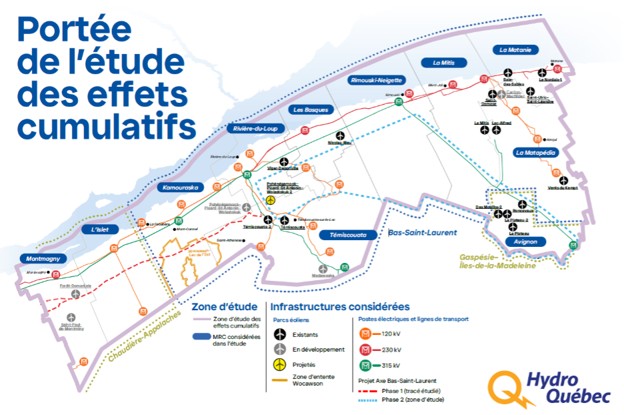
In light of this, Hydro-Québec is proactively launching a regional study on the cumulative effects of wind power and electricity transmission infrastructure in the Bas-Saint-Laurent region. This approach will provide a better understanding of the interactions between these infrastructure systems across the region, thereby guiding future planning and decision-making.
The cumulative effects assessment (CEA) is being conducted in a context where energy projects are currently being developed or planned in eastern Québec, in partnership or in cooperation with the relevant regional county municipalities (MRCs) and First Nations. These include, in particular, the Appalaches–Bas-Saint-Laurent transmission project, wind energy development in the Wocawson zone, and the Wetsok and Gespe’gewa’gi wind energy development agreements.
The CEA therefore aims to address the need expressed by certain citizens, organizations and local stakeholders for a comprehensive overview of the combined effects of projects on the land.
To conduct the assessment, Hydro-Québec has awarded a contract to two companies with complementary areas of expertise: WSP, a firm specializing in engineering, science and the environment, will carry out the assessment, while Voix Communes, which specializes in regional consultation and public engagement, will lead the community consultation efforts. This scientific and participatory approach will make it possible to assess the combined effects of energy infrastructure on the communities, the environment and land use, in order to inform future planning, mitigation measures and decisions.
The CEA will supplement—but not replace—the environmental studies, public consultations and permitting processes specific to each project.
The participatory component of the study will incorporate the knowledge of citizens, First Nations and regional organizations. The feedback collected will help clarify the issues to be studied and identify the factors considered important for the region. Workshops with the MRCs and municipalities of the Bas-Saint-Laurent region, as well as meetings with organizations and land users, will round out this consultation process.
The public can contribute to the study starting now through January 31, 2027, via a participatory platform: www.hydroquebec.com/donnezvotreavis...
The consultation to be conducted this fall will cover the entire study area. The analysis will be carried out in two phases to reflect the progress of the wind power projects. Wocawson and Wetsok will be studied first, with a report expected by the end of 2027. The easternmost portion of the Bas-Saint-Laurent region will be analyzed at a later stage, as these projects are not to be deployed in the short term.
The wind power projects and new electrical infrastructure planned for eastern Québec will generate tangible and lasting benefits for the region. Investments in energy development will create business opportunities for companies and suppliers in the region, while also supporting employment and the development of local expertise.
In addition, wind energy projects developed in partnership with the Alliance de l’énergie de l’Est (Eastern Energy Alliance) and First Nations will generate additional revenue for partner communities.
Portée de l'étude des effets cummulatifs (in french only)
Relations with the media
Hydro-Québec
November 18, 2026, Bas-Saint-Laurent
Generating more electricity in eastern Québec in collaboration with local communities: Hydro-Québec launches a regional study and public consultation on cumulative effects
November 13, 2026, General news
Hydro-Québec announces net income of $2.6 billion and investments of $5.5 billion for the first nine months of 2026
November 9, 2026, General news
Preventive replacement of certain first-generation Hilo thermostats